The word mindfulness gets used so frequently now that it has become difficult to know what it actually refers to. In popular usage, it can mean anything from a breathing exercise to a smartphone app to a company wellness initiative. In that spread of meanings, something specific and practically useful tends to get lost.
This article isn't about mindfulness as a trend. It's about the underlying practice — what it actually involves when done simply, and how it relates to something most people are quietly running short of: rest that genuinely restores.
What mindfulness practice actually is
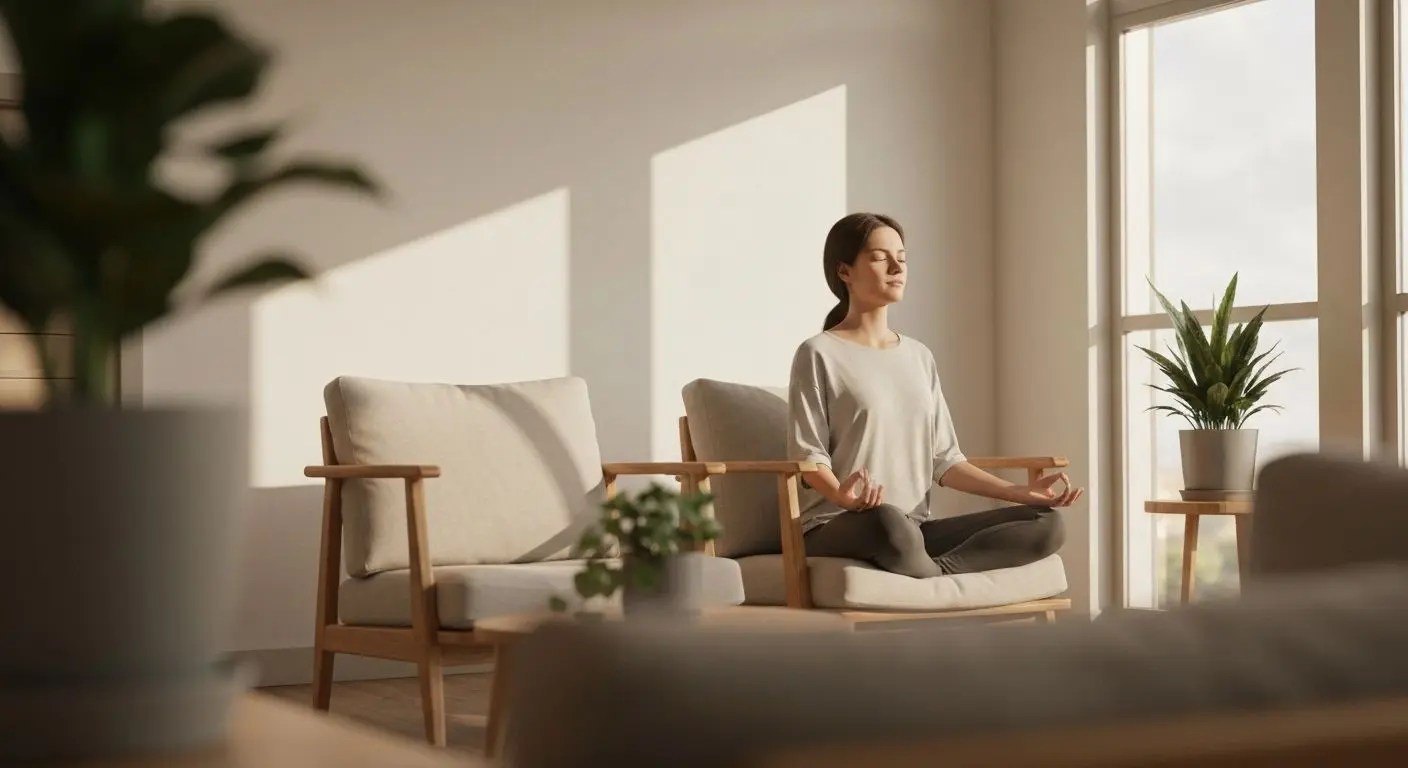
At its most basic level, mindfulness is the practice of deliberately paying attention to what is happening in the present moment — in your body, your thoughts, and your immediate environment — without immediately reacting to, judging, or trying to change what you notice.
That description sounds simple. In practice, it runs into immediate resistance. Most people who try to sit still and simply observe their experience discover within a few minutes that their mind has moved to something else entirely. A task they need to complete. Something they said yesterday. What they're going to do later. This isn't failure — it's a reliable feature of ordinary human cognition. The practice is in noticing that you've wandered, and returning. Not once, but repeatedly.
The emphasis on returning without self-criticism is important. It distinguishes mindfulness from concentration exercises, which ask you to hold attention on a single point. In attention-based practices, the wandering itself is part of the experience — you're building familiarity with how your mind moves, not trying to stop it.
The relationship between mindfulness and rest
There is a common assumption that rest means not doing anything, or not working. But most people know from experience that you can take a week off work and come back feeling no better — sometimes worse. You can sleep eight hours and wake up tired. You can sit on a beach and spend the entire time mentally processing problems from home.
Physical inactivity and rest are not the same thing. What makes rest restorative, according to several lines of practical and research observation, has more to do with the state of your attention than the absence of physical activity. Specifically, the kind of rest that actually restores tends to involve a shift away from self-referential thinking — the ongoing internal narration about what you need to do, what you should have done, how you're perceived, what might go wrong.
This is where mindfulness-based practices are relevant. Not because they guarantee any particular outcome, but because they provide a concrete method for practicing a different relationship with your own mental activity. You're not suppressing thinking — that's impossible and counterproductive. You're practicing the capacity to step back from it periodically, to notice it without being completely absorbed by it.
Types of rest beyond sleep
Sleep is the most obvious category of rest, and disrupted sleep has well-documented effects on cognitive function, mood, and physical health. But a framework that's been useful in thinking about retreat design distinguishes between several different kinds of rest that people can be running low on simultaneously:
- Physical rest — both passive (sleep, lying down) and active (gentle movement that discharges tension)
- Sensory rest — reduction of stimulation from screens, noise, and constant information input
- Mental rest — intervals of low cognitive demand, including unstructured time
- Social rest — time away from the energy of managing relationships and social performance
- Creative rest — time where your mind can wander without any task attached to it
Most standard approaches to rest address only the first category. A person who is exhausted may sleep adequately and still feel depleted if they're not addressing the others. Retreats, when they're designed thoughtfully, create conditions for multiple types of rest simultaneously — not because there's anything magical about the setting, but because removing the ordinary context of daily life removes many of the triggers that keep those other forms of depletion active.
What makes a mindfulness practice practical
One of the more common complaints about mindfulness instruction is that it's pitched at a level of detachment from daily life that feels irrelevant. Sitting for 45 minutes is genuinely not accessible to most people on most mornings. The practices that tend to actually embed in people's routines are shorter, more flexible, and tied to existing activities rather than added on top of an already full schedule.
Some examples of what this looks like in practical terms:
- Taking two minutes before starting a task to orient to where you are — not as a ritual, but as a genuine transition between activities
- Eating a meal without doing anything else, and actually noticing what you're eating
- Walking between locations without listening to audio, and paying attention to physical sensation and surroundings
- Brief pauses during work to check in with physical state — tension, posture, breathing — before returning to the task
None of these require dedicated time. They're practices of redirecting existing attention rather than creating new time slots. They won't produce dramatic results, but they build a capacity for noticing that has broader usefulness.
The limits of informal practice
Informal practices have real value, but they have a ceiling. The context of daily life exerts a strong pull. You're surrounded by the same cues, obligations, and relationships that produce the patterns you're trying to step back from. Changing attention habits in that environment is harder than doing so temporarily in a different one — not because the different environment is magical, but because it removes the contextual triggers.
This is, functionally, what a structured retreat provides. It doesn't introduce anything extraordinary. It removes the familiar. And for people who have been running on a depleted baseline for an extended period, that removal itself — before any formal practice happens — is often what creates the first sense of relief.
What to be realistic about
Mindfulness-based practices have been studied extensively over the past few decades, primarily in clinical and workplace contexts. The evidence base is real, though often overstated in popular coverage. What the research actually supports is more modest than what's typically claimed: regular practice is associated with reduced stress reactivity, modest improvements in focus, and better management of some types of anxiety and chronic pain.
It doesn't suggest that a weekend retreat will produce lasting change, or that any amount of practice eliminates difficult experience. The more grounded framing is: these are skills for relating differently to experience, and like most skills, their value depends on how consistently they're practiced and how well they fit the individual's actual life and circumstances.
For some people, a structured retreat provides the conditions to begin building those skills in a more concentrated way. For others, it offers a period of rest that isn't possible within the constraints of ordinary life. Both of those are reasonable purposes — distinct from the more inflated claims that often surround retreat marketing.
A note on expectations
People often arrive at a retreat hoping to leave feeling fundamentally different. That's a natural expectation given how the experience is typically framed. But the more useful frame is probably simpler: a retreat is time and space, held with enough structure to make rest possible. What you do with that is yours.
Rest and attention-based practice are not passive states. They require something from you — a willingness to be with what's actually present rather than what you wish were present. That's the difficulty, and also the point. Not as a path to a different self, but as a genuine encounter with the one you already are.
Note: This article is for general informational purposes. It does not constitute medical or psychological advice. If you're experiencing significant mental health concerns, please consult a qualified healthcare provider.